
Review
House of the Dragon: A Compelling Prequel That Captures the Sprawl of Empire
House of the Dragon arrives as a deliberate act of reclamation. After the seismic disappointment of Game of Thrones’ final season, HBO’s decision to return to Westeros felt risky—a gamble that audiences might have grown wary of the world’s politics and spectacle. Instead, the series proves that the problem was never the setting itself, but rather the execution. This prequel, set roughly two centuries before the events of its predecessor, charts the early fractures of the Targaryen dynasty at its most powerful, and in doing so, creates something that feels fresher and more focused than much of what came before.
The premise is elegant in its simplicity: a king makes an unprecedented choice by naming his daughter heir to the throne, breaking centuries of tradition. It’s a decision born of love and principle, yet it becomes the fault line along which an empire splinters. When that same king later fathers a son, the court erupts—not because the succession is unclear by law, but because ambition, resentment, and the weight of dynastic expectation prove far more powerful than any proclamation. The story doesn’t need dragons to be compelling, though they certainly help; it needs only the timeless combustion of power, family loyalty, and political calculation.
Performances That Ground the Spectacle
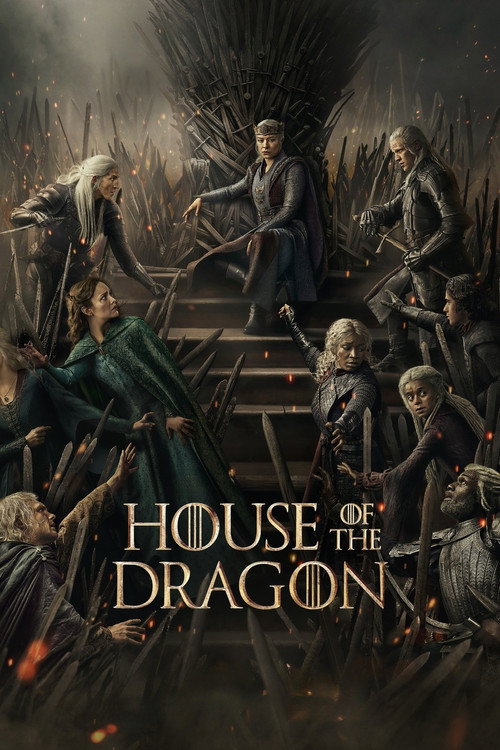
What distinguishes House of the Dragon from prestige fantasy fare is its commitment to character work. Matt Smith, as Prince Daemon Targaryen, channels both menace and vulnerability—a man of tremendous capability who is perpetually undermined by his own impulses. His scenes crackle with unpredictability; you never quite know whether he’ll prove a valuable asset or a catastrophic liability. Emma D’Arcy carries the weight of the narrative as Rhaenyra, navigating the impossible position of a woman caught between her father’s favor and the realm’s expectations. D’Arcy captures Rhaenyra’s transformation from determined young heir to someone forced to reckon with the cost of her convictions.
Olivia Cooke’s Alicent Hightower is perhaps the series’ most tragic figure. What begins as genuine affection between two women curdles into something far more complicated as the court’s machinations pull them in opposite directions. Cooke’s performance captures this deterioration with nuance—there’s no single moment where Alicent becomes an antagonist, only a gradual accumulation of slights, fears, and betrayals that transform her into one. Steve Toussaint brings gravitas to Lord Corlys Velaryon, while Fabien Frankel’s Criston Cole embodies the resentment of a talented man perpetually denied the recognition he craves.
Craft in Service of Story
The technical execution is assured throughout. The production design creates a Westeros that feels both familiar and distinct—the Red Keep is rendered with architectural weight, while Dragonstone has a volcanic, almost alien beauty. The costume design subtly tracks class, region, and allegiance through fabric and silhouette. Composer Ramin Djawadi’s score echoes the Game of Thrones theme while establishing its own identity, though the opening titles themselves are a marvel—a visual genealogy of House Targaryen told through molten gold and dragon fire.
The battle sequences and dragon confrontations, while not numerous, carry genuine stakes. The series understands that spectacle without consequence is hollow; when dragons appear, the weight of what they represent—both as instruments of power and as living, unpredictable forces—remains at the forefront. The few large-scale action sequences feel earned rather than inserted for pacing.
Thematic Depth
Beneath the dynastic scheming lies a meditation on legacy and the way power corrupts intention. Viserys’ choice to name Rhaenyra heir emerges from principle, yet his subsequent fathering of a son creates the very conflict he sought to avoid. The series asks whether such conflicts are inevitable—whether the fundamental incompatibility between maternal succession and patriarchal tradition makes bloodshed an certainty rather than a choice. It’s a question that ripples through every scene, giving even intimate character moments the weight of historical consequence.
The show is also keenly interested in how women navigate systems designed to exclude them. Rhaenyra must project strength without appearing power-hungry; Alicent must balance duty to her family with duty to the realm; Corlys’ wife, Rhaenys, watches her own claim to the throne pass over in favor of a man, and later, a child. These are not peripheral concerns—they’re central to understanding why the dynasty fractures along the lines it does.
Audience and Verdict
House of the Dragon is unambiguously a show for viewers who loved Game of Thrones but were left wanting by its conclusion. It’s also compelling television for anyone interested in political drama with fantasy trappings—the interpersonal dynamics would translate to any court intrigue, whether medieval or contemporary. The pacing is deliberate; this is not a show that rushes to action. Instead, it builds tension through conversations, glances, and the slow erosion of relationships. That approach will test patience in some quarters, but it also marks the series as a thinking person’s drama.
The first season leaves you wanting more without feeling incomplete—always the mark of confident storytelling. House of the Dragon demonstrates that the world of Westeros still has stories worth telling, and that the lessons of Game of Thrones’ missteps have been absorbed. It’s a prequel that justifies its own existence, grounded in performance, built on solid craft, and animated by genuine thematic ambition. In reclaiming this world, it may have found something better than what came before.