
Review
Avatar: Fire and Ash — A Franchise Deepens Its Wounds
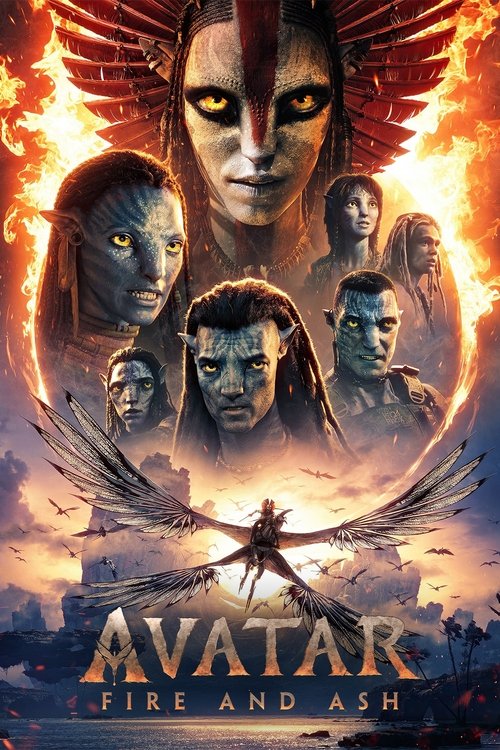
Three years after the RDA’s retreat from Pandora, James Cameron returns to his sci-fi empire with Avatar: Fire and Ash, a film that trades the wonder of colonial intrusion for something messier and more human: the costs of victory. Where the previous installment balanced spectacle with intimate family drama, this third chapter leans hard into trauma, presenting a Na’vi world fractured not by external invasion but by internal tribalism and the ghosts of conflict that refuse to stay buried.
The premise is deliberately constraining. Jake Sully (Sam Worthington) and Neytiri (Zoe Saldaña) have won their war, secured their forest, and begun rebuilding—only to discover that survival was the easier problem. The loss of their eldest son hangs over the narrative like a storm cloud, and when the Ash People emerge as an antagonistic force, the film makes a pointed choice: the new threat isn’t technological or alien, but tribal. Varang, the antagonist played with coiled menace by an actor whose name the marketing seems determined to bury, represents something the franchise hasn’t truly grappled with until now—the possibility that Na’vi culture itself contains seeds of destruction.
A Family Under Siege
Cameron’s decision to center the story on the Sully clan, rather than on broader planetary politics, is both the film’s greatest strength and its occasional limitation. Worthington and Saldaña have developed a genuine rapport over three films, and their portrayal of partners grieving while protecting remaining children feels earned. There’s no grand speech about unity here—just two people trying to keep their family alive while processing irreversible loss. The addition of Oona Chaplin and Jack Champion as family members adds generational texture, though the script doesn’t always give them room to breathe as distinct characters rather than plot devices.
Sigourney Weaver’s return as Grace, existing in fragmentary form through Pandora’s neural network, provides unexpected emotional weight. Her scenes carry a peculiar poignancy—a ghost of colonialism itself, now reduced to whispers and maternal concern. Stephen Lang, meanwhile, is given more to do as a returning antagonist, and his weathered performance suggests a man who has become something other than human through sheer will and spite. Kate Winslet and Cliff Curtis provide steadiness in supporting roles, though the film’s runtime constraints mean several characters remain more sketch than portrait.
Visual Mastery Meets Narrative Restraint
Technically, Fire and Ash is a marvel. The underwater sequences—a significant portion of the film—showcase motion capture technology that has crossed a threshold into genuine photorealism. Bioluminescent creatures move with fluid naturalism, and the way light refracts through Pandoran water creates moments of pure visual poetry. The Ash People’s environment, rendered in volcanic grays and burnt oranges, offers a striking aesthetic departure from the lush greens and blues audiences have come to expect.
Where the film occasionally stumbles is in pacing. At nearly three hours, it earns its length through visual spectacle and character moments, but there are stretches where emotional beats repeat rather than deepen. A mid-film siege sequence, while visually compelling, feels designed more for theme-park immersion than narrative momentum. The editing allows scenes to breathe, which works when dialogue carries weight but becomes indulgent when plot simply waits.
Themes of Generational Reckoning
What elevates Fire and Ash beyond spectacle is its willingness to interrogate the costs of the previous films’ heroism. Jake Sully is no longer the outsider learning Pandoran ways—he’s now the defender of a status quo, potentially blind to its vulnerabilities. The film hints at questions it doesn’t fully explore: What does a post-colonial society look like? Can integration truly work, or does it simply replace one form of dominance with another? The Ash People, for all their villainy, are presented as having legitimate grievances rooted in territorial displacement.
This moral complexity occasionally gets buried under action sequences, but it’s there—a current running beneath the spectacle suggesting that Avatar’s universe is more philosophically sophisticated than its detractors credit. The film asks its characters to reckon with the fact that survival isn’t the same as victory, and that protecting what you’ve built sometimes requires becoming the very thing you fought against.
Audience Fit
This is unquestionably a film for the Avatar faithful. Those invested in the Sully family’s arc will find rich material. Casual viewers or franchise skeptics will encounter a three-hour meditation on grief, duty, and the cyclical nature of conflict—which is not light entertainment. The action sequences are visceral and well-choreographed, but they serve character and theme rather than existing as standalone spectacle.
The film’s environmental messaging, always present in the franchise, feels more integrated here—less sermon, more lived reality. Pandora itself becomes a character with competing needs and claims, forcing the narrative away from simple good-versus-evil framings.
Final Verdict
Avatar: Fire and Ash is a film that knows what it is and commits fully to that vision. It’s not interested in expanding the franchise’s scope or introducing new continents and conflicts. Instead, it draws a circle around a family and a conflict, then examines what happens when the people you love are tested beyond their limits. The result is uneven—occasionally plodding, sometimes visually transcendent, frequently both within the same scene—but never hollow.
For those who’ve invested in this universe, it delivers the emotional reckoning the previous installment promised. For others, it remains a technically astounding but narratively familiar entry in a franchise that, for better or worse, has found its groove and shows no signs of disrupting it. Worth experiencing on the largest screen available, worth questioning afterward.