
Review
Scary Movie (2026) Review
A Franchise Revival That Proves the Joke Still Lands
Nearly three decades after the original *Scary Movie* introduced audiences to the Wayans family’s irreverent brand of horror-comedy, the franchise returns with a sequel that feels both timely and genuinely overdue. *Scary Movie* (2026) brings back the surviving members of the Core Four—the characters who spent the 2000s gleefully dismantling every horror movie trope in their path—and asks a deceptively simple question: can satire still work when the targets have evolved beyond recognition?
The premise is straightforward enough: a quarter-century after evading a relentless masked killer, our heroes find themselves back in the crosshairs of familiar evil. But this time, the filmmakers aren’t just riffing on a single genre film or moment in horror history. Instead, they’ve weaponized the entire IP landscape against itself—superhero franchises, prestige horror reboots, streaming exclusives, and the self-aware meta-commentary that has become horror’s default mode all become fair game. It’s a gambit that could easily collapse under its own ambition, yet the film mostly carries it off with style.
The Wayans Family Chemistry Remains Electric
What makes *Scary Movie* 2026 work, fundamentally, is that Marlon and Shawn Wayans still possess the comedic timing and rapport that made the original films so infectious. Their chemistry isn’t diminished by time; if anything, there’s a lived-in comfort to their banter that younger performers simply cannot manufacture. When they riff on their own mortality—both literally in the film and metaphorically as aging action heroes—the humor lands because it feels earned rather than desperate.
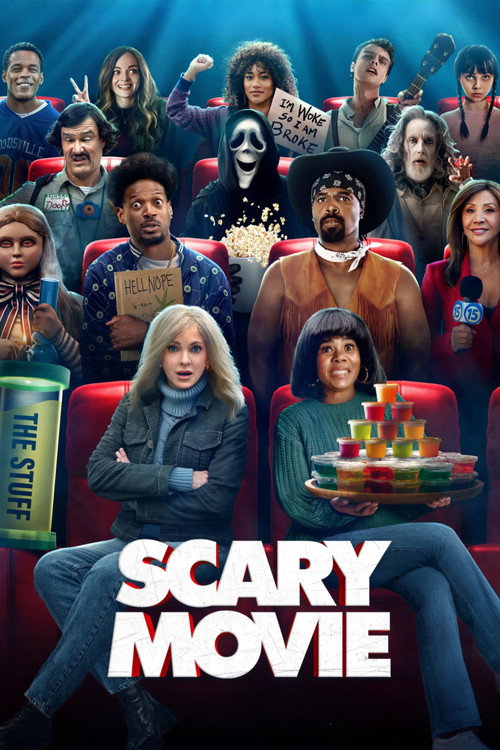
Anna Faris and Regina Hall return as well, and their presence serves as an anchor to the franchise’s golden era. Faris in particular seems liberated here, leaning into absurdity in ways that feel less constrained than her earlier appearances. The supporting cast, including Damon Wayans Jr., Gregg Wayans, and Kim Wayans, rounds out an ensemble that functions less like a collection of comedians and more like a family band that knows exactly when to let each member solo.
Benny Zielke’s role—details deliberately vague to avoid spoilers—brings fresh energy to the group dynamic. Without revealing specifics, the character serves as a bridge between the old guard sensibility and whatever passes for modern horror-comedy consciousness, which proves crucial to the film’s thematic coherence.
Satire in the Age of Self-Aware Franchises
The central tension that *Scary Movie* 2026 grapples with is genuinely interesting: how do you parody horror when horror itself has already absorbed all the self-aware irony you might throw at it? The film’s answer is not to retreat into nostalgia—though there are knowing callbacks—but to push deeper into the absurdity of IP management itself. There are pointed jokes about legacy sequels, franchise exhaustion, and the way modern horror franchises attempt to revitalize themselves through increasingly convoluted mythologies.
Not every swing lands with equal force. Some sequences feel stretched beyond their comedic limit, particularly in the second act where the film seems uncertain whether to commit fully to parody or to construct a functional thriller underneath. There’s a tonal wobble here that occasionally undermines the satire—you can sense the filmmakers wrestling with the question of whether the audience is there for plot or for punchlines.
That said, the film’s willingness to be genuinely crude and unpolished in service of a joke feels refreshing in an era of focus-grouped comedies. The Wayans’ sensibility has always been scrappy and direct, and that approach translates surprisingly well to 2026’s fractured media landscape.
Technical Execution and Craft
The cinematography and production design function as additional tools in the satirical arsenal. Horror movie aesthetics are lovingly replicated and then deliberately undermined through framing and editing choices that feel deliberately off. When the film needs to land a scare for contrast before immediately undercut it with comedy, the visual grammar feels deliberate rather than lazy.
The soundtrack operates on a similar principle—there are moments of genuine atmospheric tension that get punctured by incongruous needle drops or comedic timing choices. It’s a high-wire act, and while the film doesn’t maintain perfect balance throughout, the ambition is evident.
Who Should See This
*Scary Movie* 2026 is fundamentally a film made for people who have watched horror movies. It assumes a baseline literacy with the genre and its recent evolution. Casual viewers or those looking for straightforward scares will likely find the constant winking exhausting. But for audiences who grew up with the original films, or who appreciate horror-comedy that swings for genuine laughs rather than settling for self-satisfied smugness, this is worth your time.
It’s also specifically a film about legacy and mortality dressed up in genre-comedy clothing. The Core Four aren’t just fighting a masked killer; they’re contending with irrelevance, aging out of action, and the ways franchises both honor and discard their original creators. That thematic undercurrent gives the film more weight than it might otherwise possess.
Final Verdict
*Scary Movie* 2026 is not perfect. It’s occasionally shapeless, sometimes too pleased with its own references, and structured around jokes rather than narrative momentum. But it’s also alive in ways that feel increasingly rare—it takes genuine risks, commits to its point of view, and trusts its audience’s intelligence. The Wayans family proved nearly thirty years ago that horror-comedy could be smart and stupid simultaneously, and this film suggests that particular alchemy still has life in it. Not every joke lands, but enough do that you’ll leave with your face hurting from laughing. In an industry glutted with content designed to be safely forgotten within weeks, that feels like a genuine achievement.